- Forensic Audit Report: Federal Enforcement Actions Targeting Fraudulent and Adulterated Honey Markets (2013–2025 FY)
- U.S. Honey Importation and Domestic Distribution Channels & Economically Motivated Adulteration (EMA), Tariff Evasion, and Mislabeled Chinese-Origin Honey
- Executive Summary
- Methodology
- Findings of Fact: DOJ Criminal Enforcement Actions
- Findings of Fact: FDA Surveillance and Adulteration Detection
- Evolution of Authenticity Testing Protocols
- Industry and Policy Implications
- Audit Conclusion
Forensic Audit Report: Federal Enforcement Actions Targeting Fraudulent and Adulterated Honey Markets (2013–2025 FY)
U.S. Honey Importation and Domestic Distribution Channels & Economically Motivated Adulteration (EMA), Tariff Evasion, and Mislabeled Chinese-Origin Honey
Executive Summary
This forensic audit report reviews the coordinated enforcement efforts of the U.S. Department of Justice (DOJ)and the Food and Drug Administration (FDA)to combat illegal activities within the global and domestic honey market. Honey is consistently identified as one of the most adulterated foods in the world. The investigation focuses on two distinct yet interrelated issues: the criminal evasion of anti-dumping duties via transshipment and mislabeling, and the detection of economically motivated adulteration (EMA)
—specifically, the dilution of honey with cheap sugar syrups and contamination with unapproved antibiotics. Data indicates that while significant criminal penalties were applied in major historical cases, the regulatory detection of adulterated imports remains a persistent requirement.
Methodology
The scope of this audit covers enforcement activities from 2013 through the FDA’s projected 2025 Fiscal Year (FY) assignments. It utilizes enforcement data provided by the DOJ and FDA to trace the pathways of fraudulent products and assess the scale of tariff evasion. Additionally, testing parameters and agricultural baselines were cross-referenced with data from USDA FoodData Central
Findings of Fact: DOJ Criminal Enforcement Actions
Investigations by the Department of Justice
confirm major schemes orchestrated to evade anti-dumping duties on Chinese-origin honey and distribute adulterated products within the United States.
Major Corporate Conspiracy Case (2013)
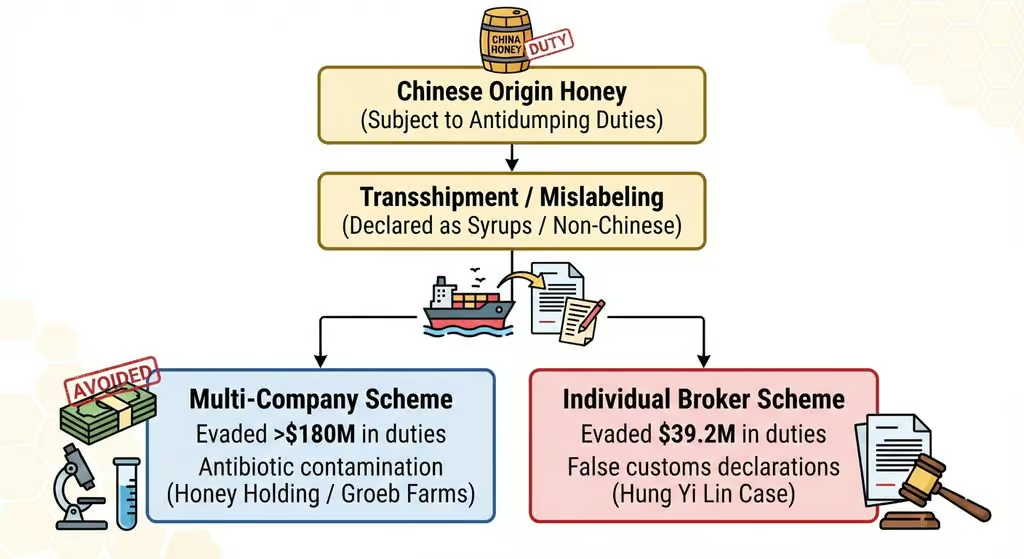
The DOJ charged two major commercial companies and five individuals following a nationwide investigation into the illegal importation of honey from China.
- Fraudulent Modus Operandi: The schemers mislabeled Chinese honey to declare a different origin, successfully avoiding required anti-dumping duties.
- Adulteration and Contamination: Testing revealed the product was adulterated with chloramphenicol, an unapproved veterinary antibiotic.
- Financial Impact: The scheme allegedly avoided over $180 million in legally required duties.
- Enforcement Outcome: Honey Holding, Inc. (doing business as Honey Solutions) and Groeb Farms both entered deferred prosecution agreements, accepted financial penalties, and were mandated to implement compliance programs.
California Broker Tariff Evasion (2013)
In a separate action, a California honey broker, Hung Yi Lin, was targeted for fraudulent customs declarations.
- Fraudulent Modus Operandi: Lin falsely declared hundreds of shipping containers of Chinese-origin honey as “sugars” and “syrups.”
- Financial Impact: This misclassification scheme resulted in the evasion of $39.2 million in tariffs.
- Enforcement Outcome: Hung Yi Lin was sentenced to three years in federal prison.
Findings of Fact: FDA Surveillance and Adulteration Detection
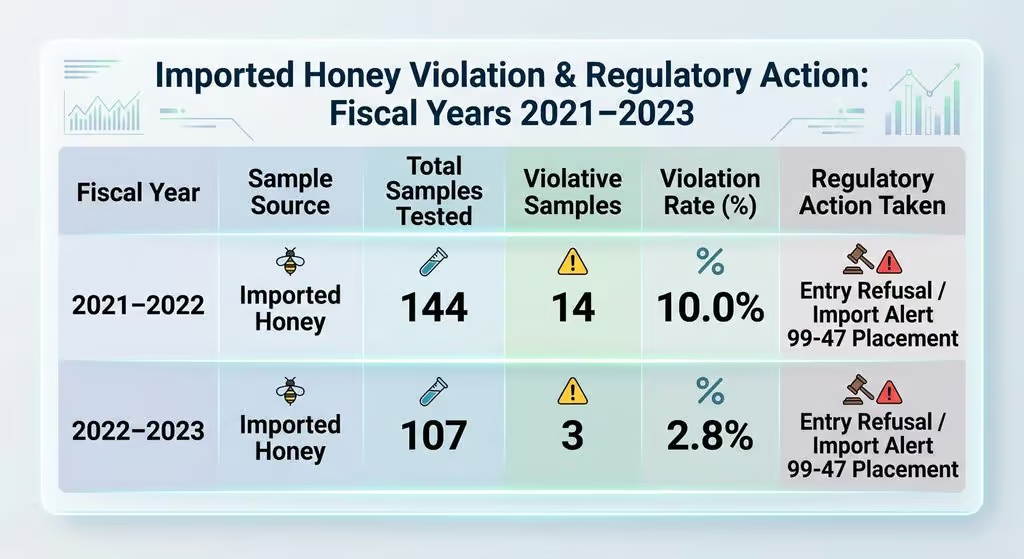
The FDA plays the critical role of detecting EMA, defined as the intentional addition of cheaper sweeteners (such as corn syrup, rice syrup, or cane sugar) to honey to maximize profits. A review of FDA surveillance data for imported honey shows fluctuating violation rates:
FDA Sampling Data (Imported Honey)
Regulatory Response
When the FDA detects a violative sample, the following regulatory actions are taken immediately:
- Refusal of entry into the United States.
- Placement of the offending company or product on Import Alert 99-47, facilitating detention without physical examination of future shipments.
Future Scope (2025 FY)
To better assess the purity of the marketplace, the FDA’s 2025 FY assignment has officially expanded its testing scope to include both imported and domestic honey products
.
Evolution of Authenticity Testing Protocols
To detect food fraud effectively, laboratories must utilize multiple screening methodologies. Historically, the FDA and the honey industry have relied on the SCIRA test (AOAC method 998.12). This test effectively detects added C4 sugar syrups obtained from corn and cane sugar. However, it does not detect C3 sugar syrups, such as those derived from beet, rice, or wheat.
To close this detection gap, the National Honey Packers and Dealer’s Association (NHPDA)
is working with the FDA to develop advanced C3 adulteration testing. Currently, the most sophisticated screening method is referred to as “State of the Art” (SOTA) testing. Endorsed by the majority of contract labs, this three-test approach includes:
- EA/LC-IRMS: 13C Stable Carbon Isotope Ratio method paired with a liquid chromatograph.
- NMR: H1 Nuclear Magnetic Resonance Profiling.
- HRMS: Liquid Chromatography-High Resolution Mass Spectrometry.
Industry and Policy Implications
A review of the industry context shows that the lack of a standardized legal definition of honey creates vulnerabilities that facilitate fraud. Currently, the Agricultural Marketing Service (AMS)
U.S. Grade A extracted honey must meet applicable requirements and achieve a minimum total score of 90 points. However, AMS grading does not provide an anti-fraud legal definition.
- Current Deficiency: The U.S. currently lacks a comprehensive federal “Standard of Identity” for honey.
- Proposed Resolution: U.S. honey producers are advocating for Congress to establish this standard, modeled on the international Codex Alimentarius.
- Expected Benefits: A clear standard would legally define what constitutes “honey,” set strict limits on additives and contaminants, and provide an enforceable metric to combat misbranding, EMA, and fraudulent labeling.
Audit Conclusion
The combined evidence indicates that the U.S. honey market remains a lucrative target for international fraud, primarily driven by the desire to evade anti-dumping duties on Chinese products and increase profit margins through adulteration with cheap syrups.
Criminal prosecutions by the DOJ
have successfully targeted major conspirators, proving that tariff evasion and antibiotic contamination were occurring on a massive financial scale exceeding $180 million. FDA data shows that EMA remains a persistent threat among imported products, with a 10% violation rate recorded as recently as 2022. The regulatory approach is now shifting toward a more comprehensive market survey—including domestic products—supported by advanced SOTA testing methodologies.
Ultimately, industry advocates maintain that a federal Standard of Identity is required as a final backstop to prevent continued misbranding and protect supply chain integrity
.
.
Frequently Asked Questions: Honey Authenticity, Processing, and Safety
Independent surveys indicate a high rate of purity in the retail market. In an RQA, Inc. survey of 74 retail honey samples across 11 US markets, 95% of the collected samples were verified as pure honey. Testing conducted by Eurofins revealed that 10 out of the 11 brands surveyed sold 100% pure honey.
Honey is consistently recognized as one of the most adulterated foods globally. EMA in the honey industry primarily involves diluting pure honey with non-honey sugar syrups. While standard FDA SCIRA testing can detect added C4 sugars (like corn and cane syrup), it fails to detect C3 sugar syrups (such as beet, rice, and wheat syrups).
To combat food fraud, the National Honey Packers and Dealer’s Association (NHPDA) recommends third-party testing using advanced methodologies. The most sophisticated “State of the Art” (SOTA) testing package includes a combination of three methods:
EA/LC-IRMS: Stable Carbon Isotope Ratio method paired with a liquid chromatograph.
NMR: H1 Nuclear Magnetic Resonance Profiling.
HRMS: Liquid Chromatography-High Resolution Mass Spectrometry.
Commercial brands often pump honey through microscopic filters to create a perfectly clear, liquid aesthetic that does not crystallize on store shelves. This ultra-filtration process completely removes natural pollen, making it impossible to trace the honey’s exact geographic and floral origins.
Processing honey at temperatures exceeding 104°F destroys natural beneficial enzymes like diastase and invertase. Intense thermal manipulation required for ultra-filtration and factory bottling often spikes Hydroxymethylfurfural (HMF) levels, indicating the honey has been thermally degraded. Excessive HMF levels can degrade into 5-sulfoxymethylfurfural (SMF), a known mutagen presenting high genotoxicity risks.
Consumers should look for brands that offer direct batch-testing transparency or rely on third-party auditing systems like True Source Certified. True Source Certification requires rigorous third-party testing and fully traceable supply chains to ensure the honey has not been economically adulterated with cheap syrups.
Infusing honey with fresh ingredients like raw garlic or jalapeños introduces significant safety risks. Fresh produce contains high water levels; if the honey’s overall moisture content rises above 20%, natural osmophilic yeasts can multiply and cause unintended fermentation. More severely, infusing high-moisture, low-acid ingredients creates a potential threat for Clostridium botulinum spores to activate in the anaerobic environment beneath the honey’s surface, producing deadly botulinum toxin.
Commercially safe infused honeys rely on fully dried or dehydrated ingredients (such as dried chili flakes or freeze-dried fruit powders) to ensure the water activity remains too low for bacterial growth. Alternatively, they use food-grade essential oils or alcohol-based extracts to add flavor without altering the honey’s structural integrity. If a small-batch producer uses fresh ingredients, the honey should generally be kept refrigerated to stall bacterial activity.