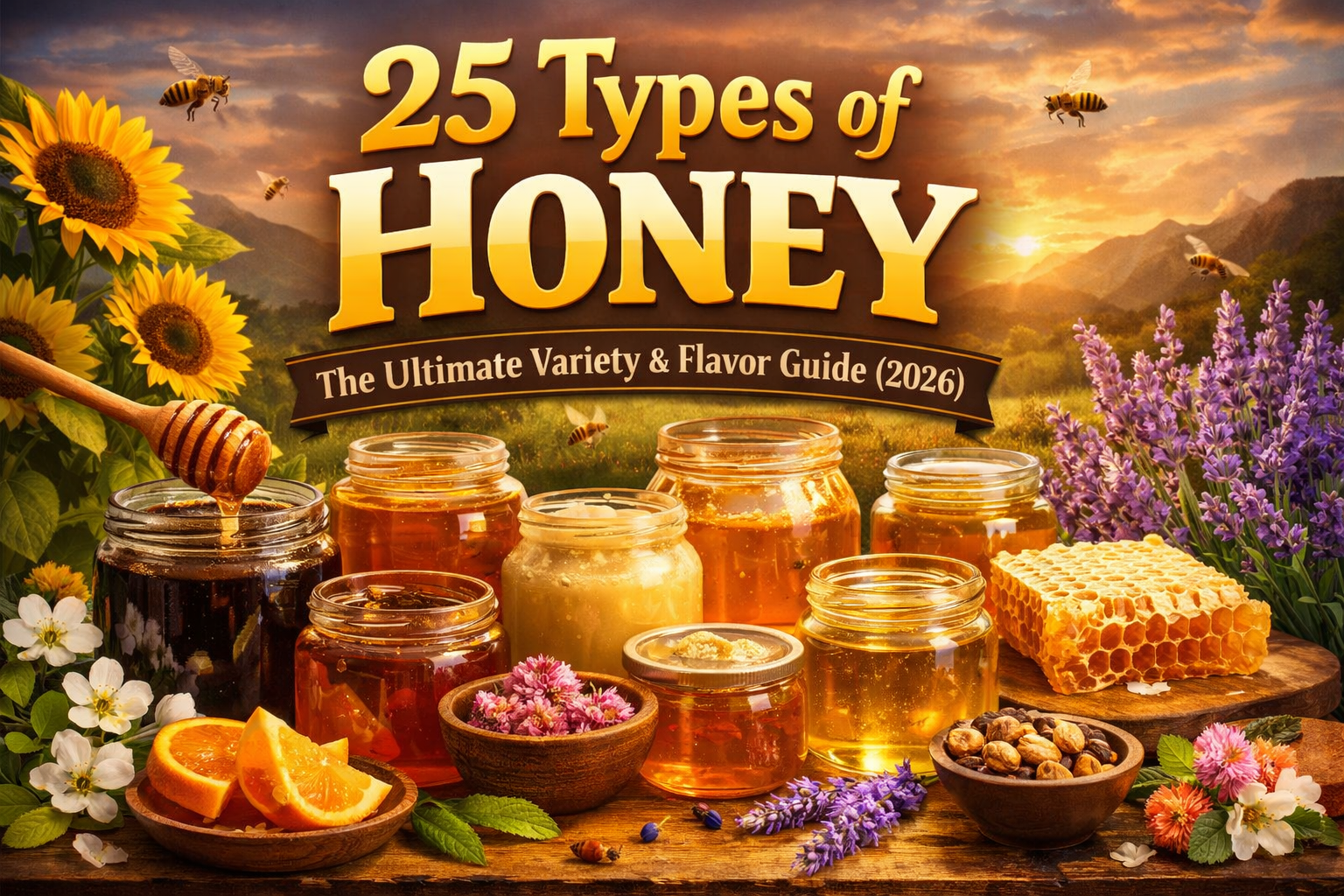
25 Types of Honey: The Ultimate Variety & Flavor Guide (2026)
There are many types of honey available, with raw honey coming in over 300 varieties, ranging from the mild, classic Clover to the rare, medicinal Manuka. Each type is defined by its floral source, which dictates its unique color, flavor profile, and health benefits.
The “Honey Variety Matrix” (The “Beat” Factor)
| Variety Name | Color (Pfund Scale) |
| Flavor Intensity | Best Use |
Among the many types of honey, Clover and Manuka are especially popular for their distinctive flavors and unique properties. The health benefits can vary greatly between different types of honey, depending on their floral origins and nutrient profiles. Each type offers specific antioxidants, enzymes, and medicinal qualities, making honey not only a delicious sweetener but also a valuable addition to a healthy lifestyle.
Category I: Light & Mild (Best for Daily Sweetening)
- Clover Honey (Trifolium repens)
- Profile: Mild, sweet, hints of cinnamon and plums.
- Pfund: 10–35mm (White to Extra Light Amber).
- Review: Is Amazon’s Happy Belly Clover Honey Real? (Note: Happy Belly is often a clover blend).
- Acacia Honey (Robinia pseudoacacia)
- Profile: Clear, glass-like, delicate vanilla notes.
- Pfund: <8mm (Water White).
- Alfalfa Honey (Medicago sativa)
- Profile: Mild, herbal, less sweet than clover.
- Pfund: 15–30mm.
- Fireweed Honey (Chamerion angustifolium)
- Profile: “The Champagne of Honey.” Silky, buttery, translucent.
- Pfund: <10mm.
- Orange Blossom Honey (Citrus sinensis)
- Profile: Explosively floral, citrus zest finish.
- Pfund: 15–34mm.
- Blue Ridge Honey Co. Orange Blossom Review
- Basswood (Linden) Honey (Tilia americana)
- Profile: Bites back with a fresh, minty, woody finish.
- Pfund: 10–25mm.
- Sage Honey (Salvia)
- Profile: Extremely slow to crystallize; sweet, clover-like but thicker.
- Pfund: <15mm.
- Cotton Honey (Gossypium)
- Profile: Mildly sweet but with a distinct “waxy” aroma.
- Pfund: 20–40mm.
- Dandelion Honey (Taraxacum)
- Profile: Sharp, pungent aroma but surprisingly gentle, chamomile taste.
- Pfund: 30–50mm.
Category II: Medium & Floral (The Gourmet’s Choice)
Honeys in this range (35–75mm Pfund) offer more “terroir”—you can taste the specific region.
- Sourwood Honey (Oxydendrum arboreum)
- Profile: Caramel, gingerbread, and a spicy finish.
- Pfund: 35–50mm.
- Dancing Bees Farm Raw Honey Review (Dancing Bees is a top NC Sourwood producer).
- Tupelo Honey (Nyssa ogeche)
- Profile: High fructose; never crystallizes. Mildly floral with a buttery texture.
- Pfund: 30–45mm.
- Wildflower Honey (Polyfloral)
- Profile: Varies by season; usually deep, complex, and “full-bodied.”
- Pfund: 50–90mm.
- Kirkland Southeast Raw Honey Review
- Blueberry Honey (Vaccinium corymbosum)
- Profile: Intensely sweet, buttery, with a tangy berry aftertaste.
- Pfund: 40–60mm.
- Lavender Honey (Lavandula angustifolia)
- Profile: Scented, herbal, camphorous notes.
- Pfund: 25–45mm.
- Mesquite Honey (Prosopis)
- Profile: Earthy, smoky, and distinctively “Southwestern.”
- Pfund: 35–55mm.
- Palmetto Honey (Serenoa repens)
- Profile: Rich, mellow, slightly fruity.
- Pfund: 50–70mm.
- Raspberry Honey (Rubus idaeus)
- Profile: Delicate, fruity, almost creamy.
- Pfund: 30–50mm.
Category III: Dark & Robust (The “Medicinal” Powerhouses)
Dark honeys (>80mm Pfund) contain the highest levels of antioxidants and minerals.
- Buckwheat Honey (Fagopyrum esculentum)
- Profile: Molasses, malty, strong “barnyard” aroma.
- Pfund: 114mm+ (Dark Amber).
- Manuka Honey (Leptospermum scoparium)
- Profile: Earthy, mineral, slightly bitter, medicinal.
- Pfund: 80–110mm.
- Wedderspoon Raw Manuka Honey Review
- Avocado Honey (Persea americana)
- Profile: Dark, heavy, tastes like molasses and burnt sugar.
- Pfund: 110mm+.
- Eucalyptus Honey (Eucalyptus)
- Profile: Bold, menthol-like, medicinal aftertaste.
- Pfund: 70–100mm.
- Tualang Honey (Koompassia excelsa)
- Profile: Rainforest honey; bittersweet, incredibly high antioxidant count.
- Pfund: 75–110mm.
- Tulip Poplar Honey (Liriodendron tulipifera)
- Profile: Dark but surprisingly mild; chocolate and jammy notes.
- Pfund: 80–110mm.
- Heather Honey (Calluna vulgaris)
- Profile: Thixotropic (jelly-like); smoky, sharp, and very aromatic.
- Pfund: 80–114mm.
- Thyme Honey (Thymus)
- Profile: Powerfully aromatic, herbal, and spicy.
- Pfund: 70–90mm.
| Honey Type | Flavor Profile | Intensity | Best Paired With |
| Acacia | Mild, sweet, floral | Low | Fresh cheeses (Ricotta, Chèvre), delicate fruits |
| Buckwheat | Malty, earthy, robust | High | Roasted meats, rye bread, strong blue cheese |
| Manuka | Medicinal, herbaceous | High | Wellness tonics, herbal teas, or enjoyed by the spoonful |
| Orange Blossom | Citrusy, bright, zesty | Medium | Greek yogurt, summer stone fruits, vanilla desserts |
| Clover | Clean, mild, grassy | Low | Daily tea, baking, or as a general sugar substitute |
| Wildberry | Fruity, rich, tart | Medium | Pancakes, waffles, or whipped into butter |
“With over 300 varieties worldwide, these 25 are just your gateway into the world of liquid gold. Whether you’re drizzling peppery Tupelo over toast or whisking smoky Avocado honey into a marinade, there is a perfect jar for every palate.”
The Raw Requirement
In 2026, the term “raw” is not just a buzzword; it is a mark of integrity. Most commercial honeys are pasteurized (heated to high temperatures) and ultra-filtered. While this makes the honey look crystal clear and stay liquid longer, it kills the beneficial enzymes and removes the microscopic pollen grains that give each variety its unique DNA.
- Look for: Labels that explicitly state “Raw” or “Unfiltered.”
- The Benefit: You get the full antioxidant profile and the natural floral essence that heat destroys.
Single-Origin vs. Wildflower
While “Wildflower” honey can be delicious, it is essentially a “mystery blend” of whatever the bees found in a general area. If you want to experience the specific notes of the 25 varieties we have discussed—like the peppery kick of Blue Curl or the buttery finish of Meadowfoam—you need Single-Origin (monofloral) honey.
- Look for: A specific floral source listed as the primary ingredient (e.g., “100% Pure Sourwood Honey”).
- Pro Tip: Check the label for a harvest location. A reputable beekeeper will often list the specific region or even the farm coordinates.
The Crystallization Myth
One of the biggest misconceptions is that “hard” or “cloudy” honey has gone bad. In reality, crystallization is the hallmark of pure, high-quality honey. Because raw honey contains natural pollens and sugars (glucose and fructose), it will eventually solidify.
- The Red Flag: If a jar of honey has been sitting on a shelf for a year and is still perfectly transparent and runny, it has likely been heavily processed or cut with corn syrup.
- The Fix: Do not toss it. Simply place the jar in a bowl of warm water (around 40°C) to return it to a liquid state without damaging the enzymes.
Quick Buying Summary
- Avoid: “Honey Blend” or “Honey Product” (these often contain added syrups).
- Seek: Glass jars over plastic (better for the environment and preserves flavor).
- Check: The “Country of Origin.” Support your local apiaries to help your local ecosystem thrive.
Proper Storage and Handling: Keeping Your Honey Immortal
Honey is famously one of the only foods that technically never expires if stored correctly. Archaeologists have found edible honey in ancient Egyptian tombs that is thousands of years old. To ensure your 25 varieties remain as fresh and delicious as the day they were jarred, follow these essential handling guidelines.
Temperature and Environment
The biggest enemies of honey are moisture and direct sunlight. Honey is hygroscopic, meaning it naturally absorbs moisture from the air, which can lead to fermentation if the container is not airtight.
- The Golden Rule: Store your honey in a cool, dry place away from direct sunlight, such as a pantry or a dark cupboard.
- Avoid the Fridge: While it is not “bad” for the honey, refrigeration significantly accelerates the crystallization process, turning your liquid gold into a hard solid much faster than necessary.
- Keep it Sealed: Always ensure the lid is screwed on tight after every use to prevent the absorption of kitchen odors and moisture.
The Metal vs. Wood Debate
You may have noticed that many connoisseurs use wooden honey dippers. There is a persistent belief that metal spoons can “kill” the enzymes in honey, particularly in high-activity varieties like Manuka.
- The Reality: Modern food-grade stainless steel is inert and will not react with honey during a quick scoop. However, honey is slightly acidic. Leaving a metal spoon submerged in a jar for long periods could theoretically lead to minor oxidation.
- The Verdict: Using a metal spoon to drizzle honey into your tea is perfectly fine. However, a wooden dipper is more than just an aesthetic choice; the horizontal grooves allow you to transport more honey without drips, making it the most functional tool for the job.
The Decrystallization Process
If your honey has turned cloudy or gritty, do not panic. This is a natural physical change, not a sign of spoilage. You can easily restore its smooth texture using the gentle “Warm Water Bath” method.
- Prepare the Bath: Place the glass jar of honey into a bowl or pot.
- Add Warm Water: Fill the bowl with warm water (approximately 40°C) until it reaches the shoulder of the jar. Avoid boiling water, as high heat destroys the delicate enzymes and floral notes.
- Wait and Stir: Let the jar sit for 15 to 20 minutes. Occasionally stir the honey to help distribute the heat evenly.
- Repeat: If the crystals remain, replace the water with fresh warm water and repeat until the honey is clear and runny again.
Sustainability: The Future of Honey and Bee Health
In 2026, the act of buying honey is more than a culinary choice; it is an environmental investment. As we navigate a changing climate, supporting the ecosystems that produce these 25 varieties is essential to ensuring they remain available for generations to come.
The Power of Buying Local
When you purchase honey from an apiary in your own region, you are doing more than supporting a small business—you are directly funding the pollination of your local environment.
- Local Pollination: Honeybees are responsible for pollinating a vast array of local flora and agricultural crops. Supporting local beekeepers ensures that healthy colonies remain in your area to maintain biodiversity.
- Reduced Carbon Footprint: Local honey does not require international shipping or heavy industrial processing. It moves from the hive to your table with minimal environmental impact.
- Seasonal Allergies: While not a clinical cure, many find that consuming honey containing local pollens helps their bodies acclimate to the local environment.
Ethical Bee Conservation
Not all honey production is created equal. Large-scale industrial honey operations sometimes prioritize yield over the welfare of the colony. Choosing sustainably sourced honey ensures that the bees are treated with the respect they deserve.
- Organic Practices: Selecting organic honey ensures that the bees are foraging in areas free from synthetic pesticides and herbicides. This leads to healthier hives and a cleaner final product for you.
- Sustainable Harvesting: Ethical beekeepers never “over-harvest.” They ensure the bees have enough of their own honey stores to survive the winter months, rather than replacing their natural food source with sugar water.
- Habitat Protection: By supporting brands that prioritize conservation, you are helping to fund the creation of pollinator-friendly habitats and research into protecting bees against pests and disease.
The Final Connection
The 25 varieties listed in this guide—from the rare Sourwood forests to the coastal tupelo groves—only exist because of a delicate balance between the honeybee and the environment. By being a conscious consumer, you become a guardian of that balance.
Sourwood honey and Tupelo honey are among the rarest. Sourwood is limited to the Southern Appalachian Mountains, while true Tupelo is found only in the White River and Apalachicola river basins during a short 2-week bloom.
Honey flavor is determined by the “terroir” and the nectar source. Bees collecting nectar from a single flower type (monofloral) produce honey with distinct chemical markers and volatile oils unique to that plant.
Manuka honey is famous for its antibacterial properties (MGO), but dark honeys like Buckwheat and Jarrah often contain higher antioxidant levels and mineral content than lighter varieties.