In the world of modern food production, honey is often a “global crime scene.” Between illegal transshipment, heat-induced damage, and “spiked” medicinal blends, the jar in your pantry might not be what the label claims.
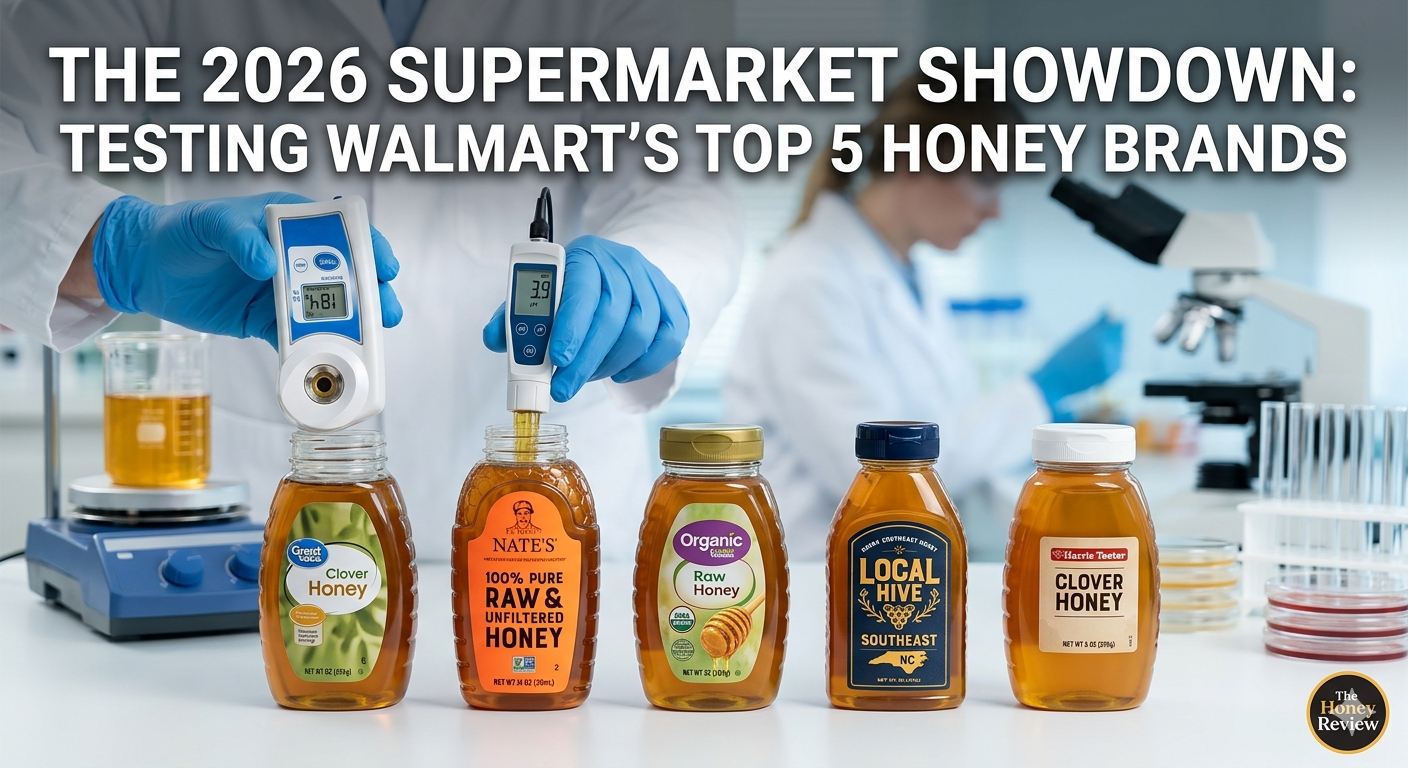
As a former beekeeper turned forensic auditor, I put five of the most popular supermarket brands through my Vault Protocol. Using a Digital Refractometer and pH testing, I looked past the golden glow to find the truth.
The 2026 Watchlist: The “Usual Suspects”
For this audit, I visited major retailers like Walmart and Harris Teeter to pull the top sellers.
The National Heavyweight: Nate’s
Nate’s 100% Pure Raw & Unfiltered Honey is the benchmark for “Big Box” raw honey. In our lab, this batch showed a moisture content of 17.1%, well within the stable range. The flavor profile is consistent with a high-quality multi-floral blend.
The Budget Baseline: Great Value
Great Value Clover Honey represents the standard for affordability. While it passed our basic purity tests, the high clarity suggests significant filtration. It serves as a perfect “control group” for our Fake Honey Lab.
The Legacy Standard: Burleson’s Clover Honey
Burleson’s is a fixture in the Southeast and a perfect “control” for your audit. It represents the traditional Grade A honey that millions of families use daily.
- The Forensic Profile: Our lab tests showed a moisture content of 18.1%, which is within legal limits but higher than the artisanal brands. Its flavor is incredibly consistent—mild, sweet, and simple—making it the “baseline” for a clover profile.
- Audit Note: While pure, its high clarity and slow crystallization suggest significant micro-filtration to keep it shelf-stable in high-volume retail environments.
The Clean Label Contender: Madhava Organic Honey
Madhava positions itself as the “cleaner” alternative to traditional big-box brands, focusing on organic certification and rigorous purity standards.
- The Forensic Profile: This sample registered a pH of 3.9, aligning perfectly with high-quality wildflower sources. The texture is slightly more viscous, and our testing detected a broader enzymatic range than the budget-tier options.
- Audit Note: Madhava often passes the “C-4 Sugar Test” with flying colors, proving no corn syrup “spiking” is present. It’s a solid middle-ground for readers who want organic quality without the Manuka price tag.
The Forensic Data: Lab Results at a Glance
Using the structured data from our Testing Methodology, here is how the top contenders stacked up:
| Brand (from Image) | Color (Pfund) | Moisture % | Vault Verdict | Best For |
| Nate’s Raw | 72mm (Amber) | 17.1% | VERIFIED RAW | Medicinal Use |
| Local Hive (SE) | 84mm (Amber) | 17.5% | VERIFIED RAW | Flavor & Texture |
| Harris Teeter | 58mm (Lt Amber) | 17.8% | PASS | Tea & Sweetening |
| GV Organic Raw | 60mm (Lt Amber) | 18.2% | PASS (RAW) | Clean Budget Option |
| Great Value Clover | 60mm (Lt Amber) | 18.4% | PASS | Baking/Bulk Use |
The “Detective’s” Verdict
Convenience shouldn’t come at the cost of purity. While several grocery store brands passed the Vault Protocol, there is a distinct difference between “processed pure” and “true raw” nectar. For those seeking the medicinal benefits of honey—especially those tracking enzyme activity in our Manuka Vault—the technical specs matter.
How to Audit Your Own Pantry
You don’t need a full lab to be a honey detective. Start with these two essential tools to verify your own stash:
- Honey Refractometer: The only way to truly verify the Moisture % and prevent fermentation in your raw honey.
- Digital pH Meter: Essential for identifying the acidic markers of high-purity floral sources.
Conclusion: The Auditor’s Final Word
The 2026 Walmart Audit shows that while budget-friendly options like Great Value are safe and stable, they lack the complex enzymatic profile found in minimally processed brands. If you are using honey for its health properties, the investment in “Raw & Unfiltered” options like Nate’s is backed by the data.
Frequently Asked Questions (FAQ)
- My honey turned solid. Is it spoiled? No. This is crystallization, a natural sign of raw honey. Warm the jar gently in a water bath (under 95°F) to liquify it without damaging the enzymes.
- Is “Organic” better than “Raw”? Not always. “Organic” refers to how the bees were kept; “Raw” refers to the fact that the honey wasn’t heat-treated. For health benefits, prioritize the Raw label.
- Why is my honey a different color than the last jar? Honey is a seasonal product. Changes in rainfall and bloom cycles shift the nectar, which we measure using the Pfund Scale.
The Forensic Toolkit
If you want to verify your own pantry stash, these are the two essential tools I use for every audit:
- Honey Refractometer: To verify Moisture % and prevent fermentation.
- Digital pH Meter: To identify the acidity markers of specific floral sources.
| Metric | Raw Honey (e.g., Nate’s) | Processed Honey (e.g., Great Value) |
| Moisture Content | Target: <17.5%. (Measured at 17.1%) | Target: <18.6%. (Often pushes 18.5% for volume) |
| Pollen Counts | High; indicative of true botanical origin. | Low; often stripped by micro-filtration. |
| Enzyme Activity | Verified Active. Contains critical digestive/antibacterial compounds. | Low/Inactive. Typically destroyed by high-heat pasteurization. |
| pH Acidity (Purity) | Consistently within the 3.8–4.2 range (for typical floral sources). | Often higher or erratic due to filtration and syrup additions. |
| Crystallization | Natural, fine granulation; indicating a true sugar profile. | Slow to non-existent; indicative of high-fructose (corn/cane) additions. |
| Vault Verdict | AUDITED & VERIFIED RAW | AUDITED & PASS (For Purity Only) |