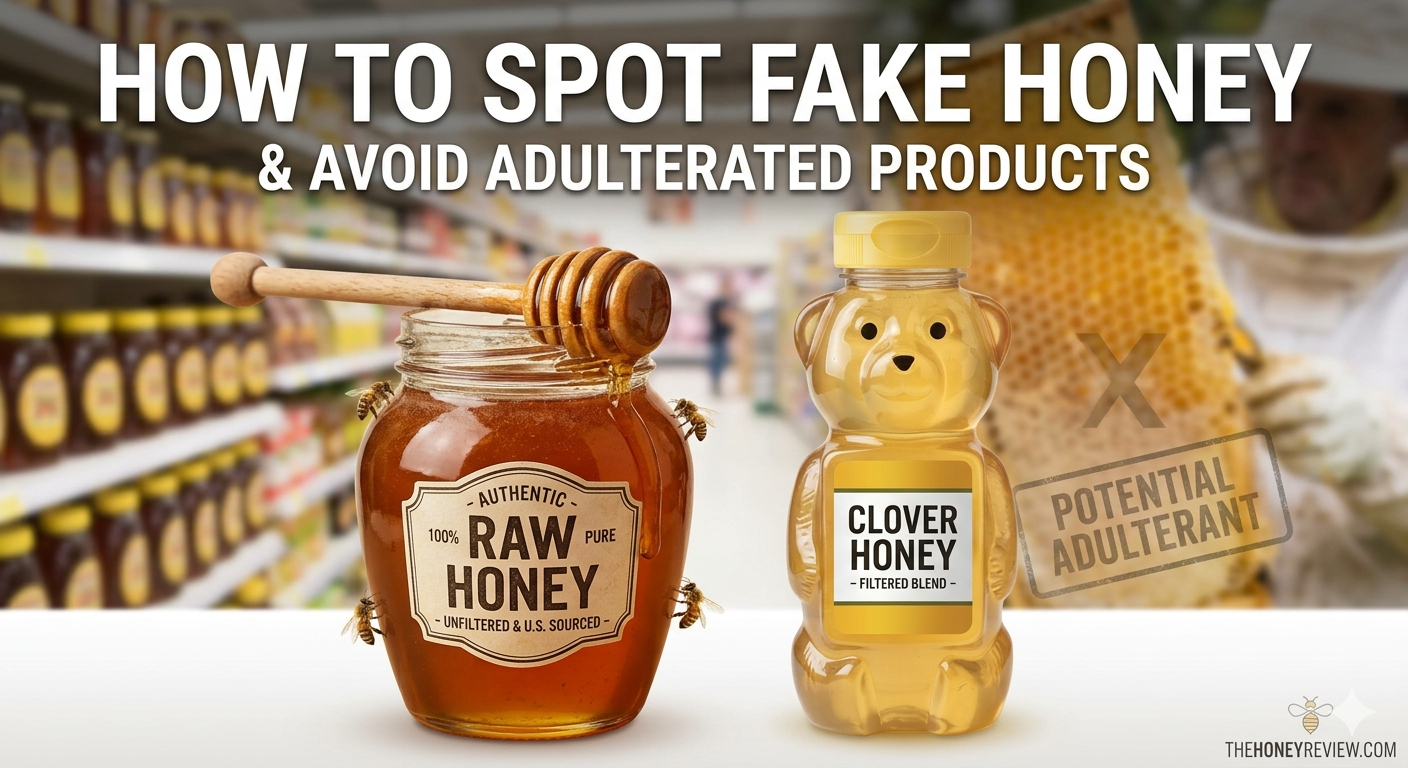
How to Spot Fake Honey & Avoid Adulterated Products
Fake honey, or adulterated honey, is a pervasive issue in the global market, with many products being cut with corn syrup, rice syrup, or high-fructose syrups. This definitive guide, powered by ‘The Honey Review’s’ lab testing standards, details the exact methods to differentiate real, raw honey from sophisticated synthetic look-alikes.
What Is Adulterated Honey? A Definition of Honey Fraud
To the average consumer, “fake honey” sounds like a single product. In reality, honey fraud is a sophisticated, multi-billion dollar global industry. In the lab, we categorize “fake” honey into four distinct levels of deception. Understanding these is the first step in protecting your health and your wallet, and how to spot fake honey.
Direct Adulteration (The “Syrup” Problem)
This is the most common form of fraud found in big-box grocery stores.
- The Process: Pure honey is “extended” by mixing it with cheap, industrially produced sweeteners.
- The Culprits: Historically, fraudsters used High Fructose Corn Syrup (HFCS). Today, they use “designer syrups” made from Rice, Wheat, or Beet, which are chemically engineered to have a similar carbohydrate profile to honey, making them nearly impossible to detect without advanced NMR testing.
- The Result: A product that looks and tastes like honey but lacks the enzymes, antioxidants, and volatile floral compounds found in the real thing.
Indirect Adulteration (The “Over-Feeding” Method)
This is a more subtle form of fraud that often happens right inside the hive.
- The Process: Beekeepers place large quantities of sugar water or sugar syrup (C4 sugars) directly in the hive while the bees are collecting nectar. Instead of foraging on wildflowers, the bees take the easy route, consuming the syrup and storing it in the combs.
- The Gray Area: While bees do need supplemental feeding in winter to survive, “harvesting” this converted sugar as “honey” is a violation of the Codex Alimentarius (the international food standard).
- The Result: The bees technically “made” it, but it isn’t floral nectar. It’s essentially “recycled sugar.”
Ultra-Filtration & Pollen Stripping
Many commercial brands engage in a process called Ultra-Filtration.
- The Process: Honey is heated to high temperatures and forced through extremely fine filters under high pressure. This removes all bee bread, wax, and—most importantly—pollen.
- Why it’s “Fake”: According to the FDA, if honey has no pollen, it is no longer honey because its geographic origin can no longer be traced.
- The Hidden Motive: Stripping pollen is often done to hide the fact that honey was sourced from restricted regions (like certain parts of Asia) and “laundered” through other countries to avoid import tariffs.
Transshipment & Origin Fraud (The “Laundering” Game)
This is a logistical fraud rather than a chemical one.
- The Process: Honey produced in one country is shipped to a second country, where it is repackaged and relabeled as “local” or from a high-value region (like New Zealand or the USA).
- The Value Gap: This is why you see “Wildflower Honey” sold at a price point that wouldn’t even cover the cost of a beekeeper’s fuel. If the price seems too good to be true for Raw Sourwood or Manuka, it is likely a victim of origin fraud.
Lab Note
In 2026, the Honey Authenticity Project estimated that nearly 40% of honey imported into the EU and US showed signs of adulteration. This is why looking for a [True Source Certified] seal is no longer just an option—it’s a necessity for the conscious consumer.
🛒 Your 60-Second “Fake Honey” Checklist
- ❌ No Crystallization: If a liquid honey stays clear for 12+ months, it’s likely ultra-filtered or cut with syrup. Real honey *will* solidify.
- ❌ “Syrup” in Ingredients: The only ingredient should be “Honey.” Beware of “High Fructose Corn Syrup” or “Rice Syrup.”
- ❌ Cheap Manuka/Sourwood: If [Manuka] or [Sourwood] is sold for under $15/lb, it is almost certainly faked. Quality has a cost.
- ❌ “Blend” of Origins: Avoid vague labels like “Blend of EU and non-EU honeys,” which are often used to mask [transshipment fraud].
- ❌ Plastic Squeeze Bottles: While not a guarantee of fraud, high-quality, [raw honeys] are almost always sold in glass jars to protect their volatile enzymes.
- ❌ No Certifications: Avoid brands without a [True Source Certified] seal or a QR code linking to their NMR lab results.
Pro-Tip: Screenshot this list for your next grocery trip!
The Complete At-Home “Real Honey” Test Guide
While professional NMR and SIRA testing are the only 100% accurate methods, there are several “kitchen table” tests that people have used for decades.This is another way on how to spot fake honey at home. Here, we separate the science from the folklore.
The Crystallization Test (Status: High Reliability)
This is the most “honest” indicator of raw, unprocessed honey.
- The Myth: “If honey turns hard or grainy, it has gone bad or is full of added sugar.”
- The Science: The opposite is true. Real, raw honey is a supersaturated sugar solution containing natural pollen and wax bits. These particles act as “seeds” for crystals. Over time, the glucose separates from the water and forms crystals.
- The Red Flag: If your honey has been sitting in a cold pantry for a year and is still as clear and liquid as the day you bought it, it has likely been ultra-filtered (stripping out the pollen) or over-heated (killing the enzymes), both of which are markers of “industrial” or fake honey.
The Solubility (Water) Test (Status: Moderate Reliability)
- The Myth: “Real honey will stay in a clump at the bottom of a glass of water, while fake honey dissolves instantly.”
- The Science: Real honey has a very low moisture content (usually under 18%) and high density. Because it is so thick, it doesn’t mix easily with water without vigorous stirring.
- The Reality Check: While this test is generally true, sophisticated “fake” honeys made with high-density rice syrups can also sink to the bottom. Use this test as a clue, not a final verdict.
The “Thumb” or “Drop” Test (Status: Low Reliability)
- The Myth: “Put a drop of honey on your thumb; if it spreads or spills, it’s fake. If it stays in a neat bead, it’s real.”
- The Science: This test only measures moisture content (viscosity).
- The Catch: A high-quality real honey that was harvested during a humid week might have a slightly higher water content (19%) and “fail” this test. Conversely, a fake honey thickened with corn starch or thickeners will “pass” easily.
The Flame (Match) Test (Status: DEBUNKED / Dangerous)
- The Myth: “Dip a match in honey and light it. If it burns, the honey is pure. If it doesn’t, the moisture in the fake honey will put out the flame.”
- The Science: This is a popular internet myth that is almost entirely useless.
- Why it fails: Many adulterated honeys are “dehydrated” in factories to have a very low moisture content, meaning they will burn just fine. Furthermore, some real, high-moisture honeys will prevent the match from lighting. We do not recommend this test.
The “Hexagon Pattern” (Memory) Test (Status: Pseudoscience)
- The Myth: “Pour water over honey in a plate and swirl it; real honey will show a hexagonal honeycomb pattern because it has ‘genetic memory.’”
- The Science: This is simply fluid dynamics. Any viscous liquid (including corn syrup) can create “Rayleigh-Bénard cells” or patterns when swirled under water. It has nothing to do with the “memory” of the bees or the purity of the honey.
| Test Phase | Procedure | Expected “Real” Result |
| 1. The Pour | Observe the flow from a spoon. | Should flow in a continuous “ribbon” that folds on itself. |
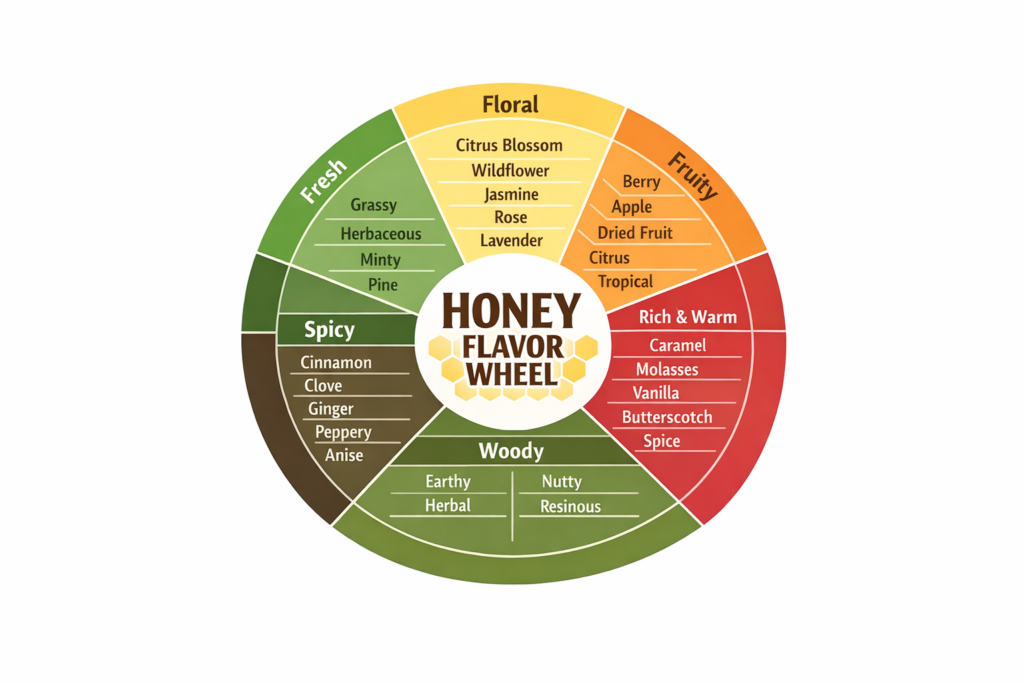
| 2. The Scent | Smell the jar immediately after opening. | Should have a floral, earthy, or “grassy” aroma. |
| 3. Solubility | Drop 1 tsp into a glass of cold water. | Should sink to the bottom in a solid clump. |
| 4. Surface Tension | Place one drop on a paper towel. | Should sit on top for 60+ seconds without soaking through. |
| 5. Texture | Rub a small amount between your fingers. | Should feel smooth, not sticky or “tacky” like syrup. |
| Total Score | (A score of 20+ indicates high probability of raw honey) | Target: 25 |
Take The Lab with you to the kitchen. Use our printable Honey Test Checklist to verify your honey at home.
Professional Lab Testing (The Gold Standards)
While at-home tests provide a good baseline, the multi-billion dollar honey fraud industry has become expert at bypassing “kitchen table” science. To be 100% certain, the industry relies on high-tech forensic analysis. This is a lab level approach on how to spot fake honey.
NMR (Nuclear Magnetic Resonance)
Think of NMR as the “DNA Test” for honey. It doesn’t just look for sugar; it looks at the entire molecular fingerprint of the jar.
- How it works: A sample is placed in a magnetic field, and the resonance of the molecules is recorded. This creates a complex wave pattern.
- The Comparison: This pattern is compared to a global database of thousands of authentic honey samples. If your “Hungarian Acacia” doesn’t match the molecular signature of known Acacia from that region, it’s flagged as fake or mislabeled.
- What it catches: Sophisticated “designer syrups” (like Rice and Beet) that mimic honey’s sugar ratios perfectly.
SIRA (Stable Isotope Ratio Analysis)
SIRA is the primary tool for detecting C4 Plant Adulteration.
- The Science: Most honey-producing flowers are C3 plants. Cheap fillers like Corn and Sugar Cane are C4 plants. These two groups process carbon isotopes differently.
- The Detection: SIRA measures the ratio of Carbon-13 to Carbon-12. If the ratio leans toward the C4 side, it’s a “smoking gun” that the bees were fed corn syrup or the honey was cut with cane sugar.
Pollen Analysis (Melissopalynology)
Pollen is the “fingerprint” of the hive’s location.
- The Process: A lab technician uses a high-powered microscope to identify the types of pollen grains in the honey.
- The Fraud Detection: If a jar is labeled “Local North Carolina Sourwood” but contains 80% Eucalyptus pollen (found in Australia), the lab knows the honey has been Transshipped—illegally rerouted and relabeled to hide its true origin.
The Crystallization Test is the most reliable long-term indicator. Real, raw honey contains natural pollen and wax that cause it to solidify over time. If your honey remains perfectly clear and liquid for over a year in a cool pantry, it has likely been ultra-filtered or adulterated with sugar syrups.
While the Solubility (Water) Test is a good indicator of density, it is not 100% foolproof. Real honey will sink in a clump because of its low moisture content (under 18%), but modern “fake” honeys made from high-density rice syrups can mimic this behavior. It should be used as a clue, not a final verdict.
Many large-scale producers use ultra-filtration to remove pollen. This prevents crystallization (keeping it liquid longer) but also removes the “geographic fingerprint” of the honey. This is often done to hide the fact that the honey was sourced from restricted regions and “laundered” to hide its true origin.
is a laboratory “DNA test” for honey. It maps the molecular structure of the sample and compares it to a global database of thousands of authentic honeys. It is the only way to detect sophisticated C3 syrups (like rice and beet) that at-home tests and older lab methods (SIRA) might miss.
is a voluntary program where participants agree to independent audits and SIRA testing. While it is a massive step up from uncertified honey and provides an excellent audit trail to prevent “transshipment” fraud, it is best when combined with modern NMR testing for total purity assurance.
Is Your Supermarket Honey Real? The Truth Behind the 2011 “Honey Laundering” Scandal Have you ever looked at that golden bear in your pantry and wondered if it’s actually honey? For many Americans, the answer might be “not exactly.” Supermarket honey fraud is a deep problem in the Industry. Honey fraud, or “economically motivated adulteration,”…
Continue Reading Supermarket Honey Fraud: The 2011 “Honey Heist” & How to Spot Fakes

Let’s get real. Most of what’s sold as “honey” in grocery stores isn’t honey—it’s heat-treated syrup wrapped in golden lies. If the jar on your shelf came from a big-box brand, chances are it’s been stripped of everything good: enzymes, pollen, even origin transparency. That doesn’t just dilute the flavor—it erases the story. Raw honey,…
Continue Reading Raw Honey: A Sticky Truth They Don’t Want You to Taste

Raw honey isn’t just a sweet treat—it’s a natural powerhouse with benefits that stretch far beyond your morning toast. Whether you’re a wellness enthusiast or just honey-curious, here are five timeless ways to make the most of every golden drop. 1. Natural Skin Soother When it comes to natural skincare, raw honey is basically the…
Continue Reading 5 Everyday Uses for Honey | Go Beyond the Breakfast Table
The Truth About Nature Nate’s Honey: Heated, Not Raw, and High in HMF Honey has been cherished for thousands of years, not just for its sweet taste but also for its numerous health benefits. However, not all honey is created equal. The quality and purity of honey can vary significantly depending on how it is…
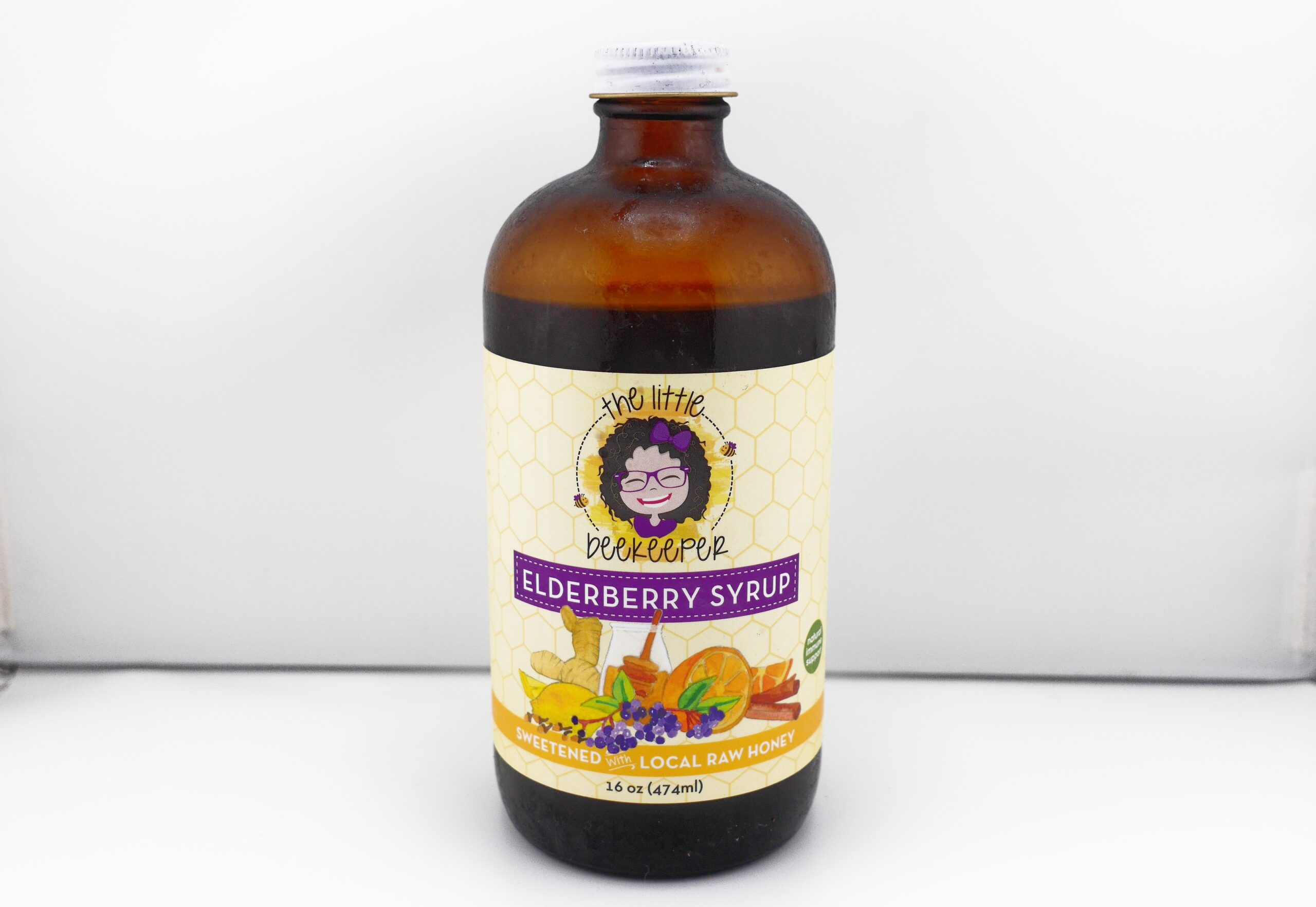
As a beekeeper and honey enthusiast based in Charlotte, NC, I am always on the lookout for high-quality, natural products that support wellness. It’s even better when they’re locally sourced. The 16oz Organic Premium Elderberry Syrup – The Little Beekeeper has truly impressed me. It’s great all year long, but especially during the fall season.…
Continue Reading The Little Beekeeper : Elderberry Syrup Review

Designer Honey in Supermarkets Risks Health and Beekeepers’ Incomes Howdy y’all! Today, we’re diving into a sticky situation that’s been buzzing around the honey world. We’re talking about designer honey in supermarkets and how it’s putting our health and hardworking beekeepers’ incomes at risk. So grab a cup of sweet tea, sit back, and let’s…
Continue Reading Designer Honey Risks Health and Beekeepers’ Incomes