Forensic Audit: The Sticky Truth – Decoding the “Golden Deception”
In the landscape of modern food production, honey has become a high-stakes industrial theater. While we champion the unfiltered honesty of local Carolina labels like Moon’s Honey House, we must confront a hard reality: the majority of store-bought honey is a nutritional imposter. If your honey comes in a plastic bear and refuses to crystallize, you aren’t consuming a superfood—you’re consuming a heat-treated shadow of what the bees intended.
The “Sticky Truth” is that the grocery store shelf is often a staging ground for a global heist. Major brands often hide behind terms like “pure” and “natural” while stripping the honey of its biological soul through high-heat processing and ultrafiltration. We put the industry-standard “Commercial Honey” through The Lab’s Forensic Protocol to expose the mechanical shortcuts and thermal damage that Big Honey uses to keep their product clear, cheap, and dead.
The Forensic Profile: Commercial vs. Raw
- The Target: Big-Box “Pure” and “Organic” mass-market labels
- The Methodology: Ultrafiltration and Flash-Pasteurization
- The Goal: Absolute shelf-life stability and origin obfuscation
- The Casualties: Diastase enzymes, native pollen, and consumer health
- Vault Status: REJECTED (Mass-market brands consistently fail our “Pollen Traceability” audit)
- Status: Read the full exposé on the “Honey Hoax”
1. The Great Honey Hoax: Thermal Execution
The deception begins at the heat exchanger. Industrial processors flash-pasteurize honey to prevent it from granulating on the shelf and to make it pump through factory lines like water.
- Forensic Observation: This thermal shock destroys the delicate enzymes that provide honey its antibacterial properties. Furthermore, high heat triggers the formation of Hydroxymethylfurfural (HMF), a compound we’ve documented at toxic levels in brands like Nature Nate’s.
- The Lab Verdict: Industrial heat turns a functional food into a simple sweetener. It is the difference between fresh, cold-pressed juice and a shelf-stable fruit drink.
2. The Pollen Conspiracy: Erasing the Fingerprint
Pollen is the “biological fingerprint” of the hive. It allows forensic labs to determine exactly which flowers—and which countries—the honey came from.
- The Ultrafiltration Tactic: Major brands often use high-pressure filtration to remove every grain of pollen.
- The Motivation: Without pollen, the honey is untraceable. This allows “Big Honey” to blend syrups from multiple countries (often those with lax safety regulations) and label it “100% Pure.”
- Beekeeper Rule: As a beekeeper, I live by one code: No pollen, no proof. If you can’t trace it, don’t taste it.
3. Reclaiming the Hive: Raw Honey as a Cultural Protest
Choosing raw honey is an act of rebellion. It means choosing traceability over convenience. Raw honey is unpredictable, sometimes messy, and often “cloudy”—and that is exactly why it is superior.
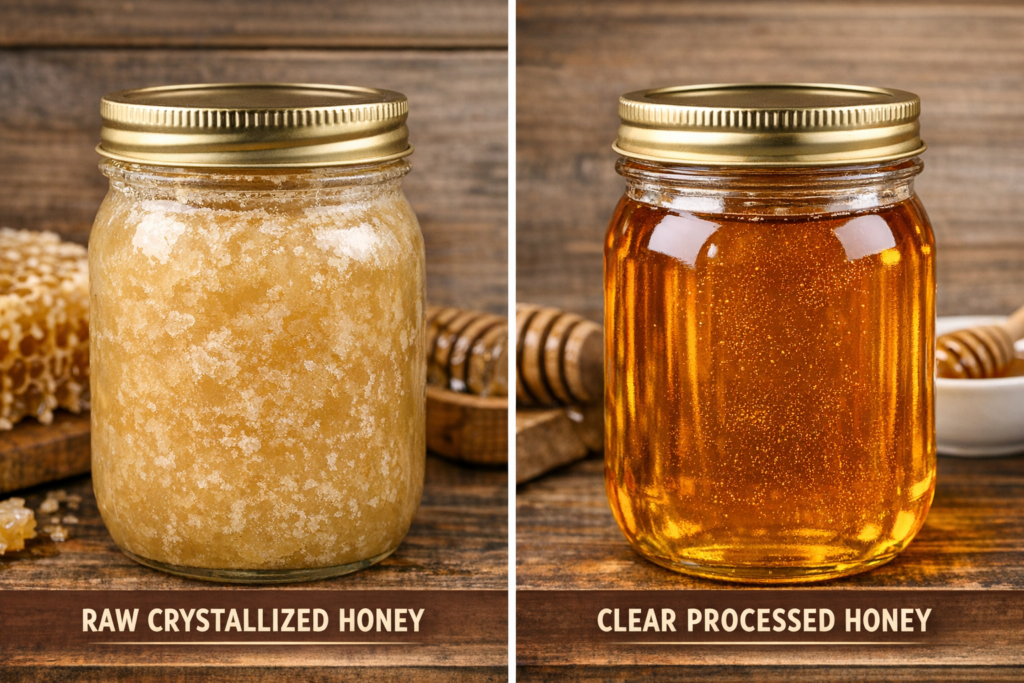
- The Texture “Signature”: Raw honey refuses to be uniform. One jar might be liquid like the Cloister Scotch Infusion, while another might be as thick as lard.
- The Feature, Not a Flaw: Crystallization is the ultimate sign of integrity. If your honey grains up, it hasn’t been “killed” by heat.
4. The “Honey Heist” Hit List
Based on our forensic testing and industry reports, these brands often prioritize factory efficiency over hive health:
- Nature Nate’s: Linked to high-heat processing and HMF spikes.
- Sue Bee: Often criticized for lack of sourcing transparency.
- Golden Blossom: Marketed as premium but frequently pasteurized.
- Busy Bee: Known for ultrafiltration and blending international imports.
Forensic Scorecard: Raw vs. Processed
| Feature | Raw Honey | Commercial “Pure” Honey |
| Processing | Cold Extraction / Gravity Strained | Flash-Pasteurized / Ultrafiltered |
| Pollen Content | Intact (Traceable) | Stripped (Hidden Origin) |
| Flavor Profile | Complex, Seasonal, Earthy | Flat, Uniform, Sweet |
| Texture | Crystallizes Naturally | Stays Liquid Indefinitely |
| Health Benefits | Active Enzymes & Pollen | Primarily Simple Sugars |
The Quick Breakdown
| Forensic Pros (Raw Honey) | Forensic Cons (Commercial) |
| Bio-Active: Retains all 5,000+ enzymes and minerals. | Nutritionally Void: Heat neutralizes the healing power. |
| Transparent: Can be traced back to a specific field or beekeeper. | Mystery Blend: Often a “cocktail” of global syrups. |
| Supports Local: Funds ethical apiaries and urban bees. | Supports Monoculture: Funds industrial-scale factory hives. |
The Verdict
Buy Raw if: You want a functional superfood that actually supports your local ecosystem and provides a flavor profile that can’t be faked.
Skip Commercial if: You are looking for anything beyond a simple sweetener. Store-bought “honey” is essentially a syrup with honey flavoring. If you’re in North Carolina, skip the supermarket bear and find John Moon at the Regional Farmers Market for the real deal.
Forensic “Pro-Tip” for 2026
Don’t be afraid of the jar! Raw honey should be eaten straight from the spoon to get the full benefit of its enzymes. If you’re giving it to your kids, a tablespoon before bed is a family tradition in my house. Just remember: never stir your raw honey into boiling water—it’s the “thermal executioner” of the very benefits you’re paying for.
In the US, “Organic” for honey is tricky because you can’t tell a bee where to fly. Focus on “Raw and Unfiltered” from a beekeeper you can talk to. Local beats “Organic” every single time.
That is Crystallization, and it’s a good thing! It means your honey is raw and unfiltered. To make it liquid again, just give it a warm (not boiling) bath in a bowl of water.
Always look for a harvest date. If a brand can tell you when the bees made it, they’re likely doing it right. Check out our Full Reviews Directory to see which brands passed our lab test.