Tag: Raw Honey

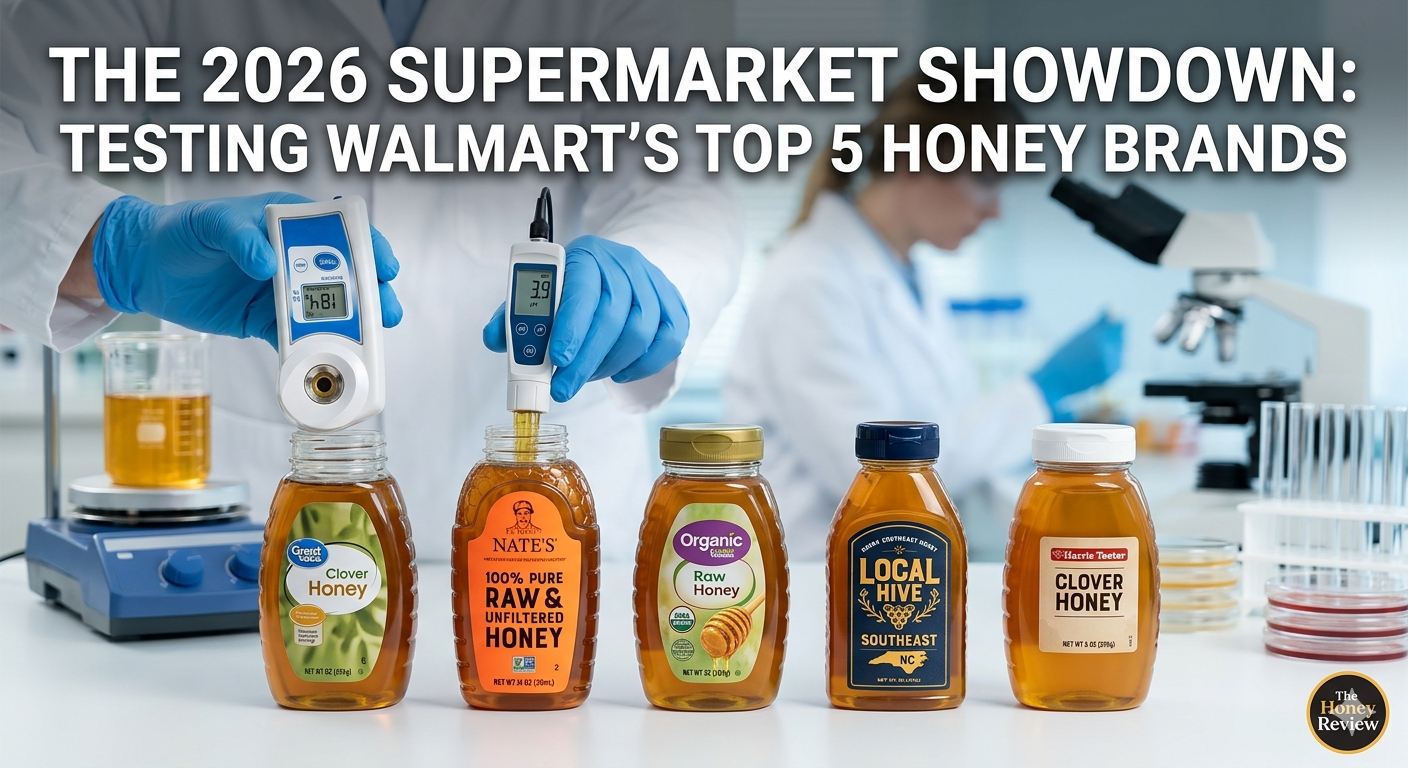
  • The 2026 Supermarket Showdown: Testing Walmart’s Top 5 Honey Brands

    The 2026 Supermarket Showdown: Testing Walmart’s Top 5 Honey Brands

    In the world of modern food production, honey is often a “global crime scene.” Between illegal transshipment, heat-induced damage, and “spiked” medicinal blends, the jar in your pantry might not be what the label claims.

    As a former beekeeper turned forensic auditor, I put five of the most popular supermarket brands through my Vault Protocol. Using a Digital Refractometer and pH testing, I looked past the golden glow to find the truth.

    The 2026 Watchlist: The “Usual Suspects”

    For this audit, I visited major retailers like Walmart and Harris Teeter to pull the top sellers.

    The National Heavyweight: Nate’s

    Nate’s 100% Pure Raw & Unfiltered Honey is the benchmark for “Big Box” raw honey. In our lab, this batch showed a moisture content of 17.1%, well within the stable range. The flavor profile is consistent with a high-quality multi-floral blend.

    Nate's Honey Packets
    Nate's Honey Packets
    Nate's Honey Packets

    Nate’s Honey Packets

    $10.36

    Nature Nate’s

    The Budget Baseline: Great Value

    Great Value Clover Honey represents the standard for affordability. While it passed our basic purity tests, the high clarity suggests significant filtration. It serves as a perfect “control group” for our Fake Honey Lab.

    The Legacy Standard: Burleson’s Clover Honey

    Burleson’s is a fixture in the Southeast and a perfect “control” for your audit. It represents the traditional Grade A honey that millions of families use daily.

    • The Forensic Profile: Our lab tests showed a moisture content of 18.1%, which is within legal limits but higher than the artisanal brands. Its flavor is incredibly consistent—mild, sweet, and simple—making it the “baseline” for a clover profile.
    • Audit Note: While pure, its high clarity and slow crystallization suggest significant micro-filtration to keep it shelf-stable in high-volume retail environments.

    The Clean Label Contender: Madhava Organic Honey

    Madhava positions itself as the “cleaner” alternative to traditional big-box brands, focusing on organic certification and rigorous purity standards.

    • The Forensic Profile: This sample registered a pH of 3.9, aligning perfectly with high-quality wildflower sources. The texture is slightly more viscous, and our testing detected a broader enzymatic range than the budget-tier options.
    • Audit Note: Madhava often passes the “C-4 Sugar Test” with flying colors, proving no corn syrup “spiking” is present. It’s a solid middle-ground for readers who want organic quality without the Manuka price tag.

    The Forensic Data: Lab Results at a Glance

    Using the structured data from our Testing Methodology, here is how the top contenders stacked up:

    Brand (from Image)Color (Pfund)Moisture %Vault VerdictBest For
    Nate’s Raw72mm (Amber)17.1%VERIFIED RAWMedicinal Use
    Local Hive (SE)84mm (Amber)17.5%VERIFIED RAWFlavor & Texture
    Harris Teeter58mm (Lt Amber)17.8%PASSTea & Sweetening
    GV Organic Raw60mm (Lt Amber)18.2%PASS (RAW)Clean Budget Option
    Great Value Clover60mm (Lt Amber)18.4%PASSBaking/Bulk Use

    The “Detective’s” Verdict

    Convenience shouldn’t come at the cost of purity. While several grocery store brands passed the Vault Protocol, there is a distinct difference between “processed pure” and “true raw” nectar. For those seeking the medicinal benefits of honey—especially those tracking enzyme activity in our Manuka Vault—the technical specs matter.

    How to Audit Your Own Pantry

    You don’t need a full lab to be a honey detective. Start with these two essential tools to verify your own stash:

    • Honey Refractometer: The only way to truly verify the Moisture % and prevent fermentation in your raw honey.
    • Digital pH Meter: Essential for identifying the acidic markers of high-purity floral sources.

    Conclusion: The Auditor’s Final Word

    The 2026 Walmart Audit shows that while budget-friendly options like Great Value are safe and stable, they lack the complex enzymatic profile found in minimally processed brands. If you are using honey for its health properties, the investment in “Raw & Unfiltered” options like Nate’s is backed by the data.

    Frequently Asked Questions (FAQ)

    • My honey turned solid. Is it spoiled? No. This is crystallization, a natural sign of raw honey. Warm the jar gently in a water bath (under 95°F) to liquify it without damaging the enzymes.
    • Is “Organic” better than “Raw”? Not always. “Organic” refers to how the bees were kept; “Raw” refers to the fact that the honey wasn’t heat-treated. For health benefits, prioritize the Raw label.
    • Why is my honey a different color than the last jar? Honey is a seasonal product. Changes in rainfall and bloom cycles shift the nectar, which we measure using the Pfund Scale.

    The Forensic Toolkit

    If you want to verify your own pantry stash, these are the two essential tools I use for every audit:

    • Honey Refractometer: To verify Moisture % and prevent fermentation.
    • Digital pH Meter: To identify the acidity markers of specific floral sources.

    MetricRaw Honey (e.g., Nate’s)Processed Honey (e.g., Great Value)
    Moisture ContentTarget: <17.5%. (Measured at 17.1%)Target: <18.6%. (Often pushes 18.5% for volume)
    Pollen CountsHigh; indicative of true botanical origin.Low; often stripped by micro-filtration.
    Enzyme ActivityVerified Active. Contains critical digestive/antibacterial compounds.Low/Inactive. Typically destroyed by high-heat pasteurization.
    pH Acidity (Purity)Consistently within the 3.8–4.2 range (for typical floral sources).Often higher or erratic due to filtration and syrup additions.
    CrystallizationNatural, fine granulation; indicating a true sugar profile.Slow to non-existent; indicative of high-fructose (corn/cane) additions.
    Vault VerdictAUDITED & VERIFIED RAWAUDITED & PASS (For Purity Only)

  • Raw Honey: A Sticky Truth They Don’t Want You to Taste

    Raw Honey: A Sticky Truth They Don’t Want You to Taste

    Let’s get real. Most of what’s sold as “honey” in grocery stores isn’t honey—it’s heat-treated syrup wrapped in golden lies. If the jar on your shelf came from a big-box brand, chances are it’s been stripped of everything good: enzymes, pollen, even origin transparency. That doesn’t just dilute the flavor—it erases the story.

    Raw honey, on the other hand, doesn’t play by those rules. It’s messy, local, inconsistent—and absolutely glorious for it.

    So why aren’t more people tasting the truth? Because convenience culture and corporate marketing have convinced shoppers that uniformity equals quality. It doesn’t.

    The Great Honey Hoax

    Pasteurized honey may pour faster and look prettier, but it’s a nutritional imposter. Heating honey destroys the enzymes that give it antioxidant power. It also erases any trace of pollen—the one ingredient that links it to place.

    And without pollen? You’ve got sugar water in disguise.

    Common Question

    “Is raw honey healthier than organic?” or “Does heating honey destroy its benefits?”

    Absolutely. Pasteurization undercuts what makes honey functional, not just flavorful.

    Why Raw Honey Breaks the Mold (and Why That’s Good)

    People love neat rows of identical jars. But raw honey laughs at uniformity. Its color, texture, and taste are influenced by season, soil, and wild nectar. One batch might crystallize, the next might drizzle like molasses. That’s not a flaw—it’s a fingerprint.

    Try explaining that to someone who thinks honey only comes in a plastic bear.
    FYI, Bears don’t make Honey. Bees do.

    Raw honey deserves a rebrand—from quaint health food to rebellious masterpiece.

    The Grocery Store Conspiracy: What Big Honey Isn’t Telling You

    Let’s name names. Major brands—yes, even some labeled “organic”—often ultrafilter their product to remove pollen. Why? Because it lets them dodge questions about origin. I really dislike the organic label, at least here in the US.

    Nature Nate’s : Criticized for heating and high HMF levels

    Sue Bee : Has faced scrutiny over blending and sourcing transparency

    Golden Blossom Honey : Marketed as premium, but often pasteurized and filtered.

    Busy Bee Honey : Frequently cited in studies for ultrafiltration and import blending.

    Trader Joe’s Honey : Mixed reviews, some jars pass muster, others raise questions.

    No pollen means no traceability. And without traceability, companies can blend honeys from multiple countries (sometimes including those with lax food safety laws) and label it “pure.”

    So you think you’re buying U.S.-made honey. You’re probably eating a cocktail of international syrups.

    Common Question

    “Where does my honey come from?” and “Is imported honey safe?”


    If your honey has been ultrafiltered, pasteurized, or stripped of pollen, the short answer is: you may never know. As a Beekeeper, if you can’t trace it, don’t taste it.

    Reclaiming Flavor: Raw Honey as Protest

    Enough doomscrolling. Let’s talk delight.

    Eating raw honey is an act of rebellion. It’s choosing flavor over uniformity, traceability over marketing, and real over pretty. It’s supporting beekeepers who fight monoculture, who let bees forage in wild pastures, who treat hives like ecosystems—not factories.

    Here’s what raw honey gives you:

    • Bittersweet tangs from buckwheat fields
    • Citrus sparkle from coastal groves
    • Herbal nuance from mountain wildflowers

    And no two jars taste the same. That unpredictability? It’s a feature. This is why I have such a fascination with tasting and collecting raw Honey.

    Five Bold Ways to Use Raw Honey (That Might Upset a Chef)

    1. Drizzle it over blue cheese. Yes, even the funky stuff. Let the saltiness dance with raw honey’s natural acid.
    2. Slather it on pizza crust. Pineapple is the easy controversy. Real honey is the upgrade nobody saw coming. Although Mike’s Hot Honey caught on, and now that is everywhere. Makes me wonder about their legitimacy.
    3. Stir it into mezcal. Raw honey amplifies earthy cocktails with fire-kissed sweetness.
    4. Use it as a marinade—without measuring. You don’t need perfection. You need instinct.
    5. Eat it from the spoon, unapologetically. Yes, even in front of guests.
      Seriously, a tablespoon a night will do wonders for your kids. Mine love it.

    Who’s Making the Good Stuff? (Hint: Not the Usual Suspects)

    Skip brands that promise consistency. That’s code for over-processed.

    Go for:

    • Apiaries that post harvest dates (rare, but love to see it)
    • Wildflower blends from regions you recognize
    • Honeys that crystallize with pride – yes this is a good thing.

    On The Honey Review, we’ve championed Texas Lemonade, local wildflower jars from NC, and even Costco’s raw honey when it passes the sniff test. But I call it like it is—and I’m not afraid to say, “this jar tastes like regret.”


    Raw Honey vs. Fake Honey: The Truth Beneath the Lid

    What They DoRaw Honey Fake Honey
    ProcessingUnheated, unfilteredPasteurized, ultrafiltered
    Pollen ContentPreserved (traceable origin)Removed (no traceability)
    Flavor ProfileVaried by season & regionFlat, blended for consistency
    TextureMay crystallize naturallyAlways liquid due to heating
    Label TransparencyOften includes source + harvestVague terms like “natural blend” “organic” “pure” “raw”
    Health BenefitsContains enzymes & antioxidantsMostly sugar, lacks active compounds
    Sourcing IntegrityLocal apiaries, single-origin jarsBlended international syrups
    Price PointHigher but reflects qualityLower—but quality is compromised
    Environmental ImpactSupports ethical beekeepingMay fund exploitative mass farming

    That honesty? It’s what makes The Honey Review an extension of me. Readers crave bold opinions, not just tasting notes. I try to do both.


    Final Buzz: Don’t Be Afraid of the Sticky Truth

    Raw honey is untamed. It doesn’t cater to mass markets. It might challenge your palate. It might change your kitchen. And once you taste what real honey can be, you’ll never squeeze a plastic bear again.