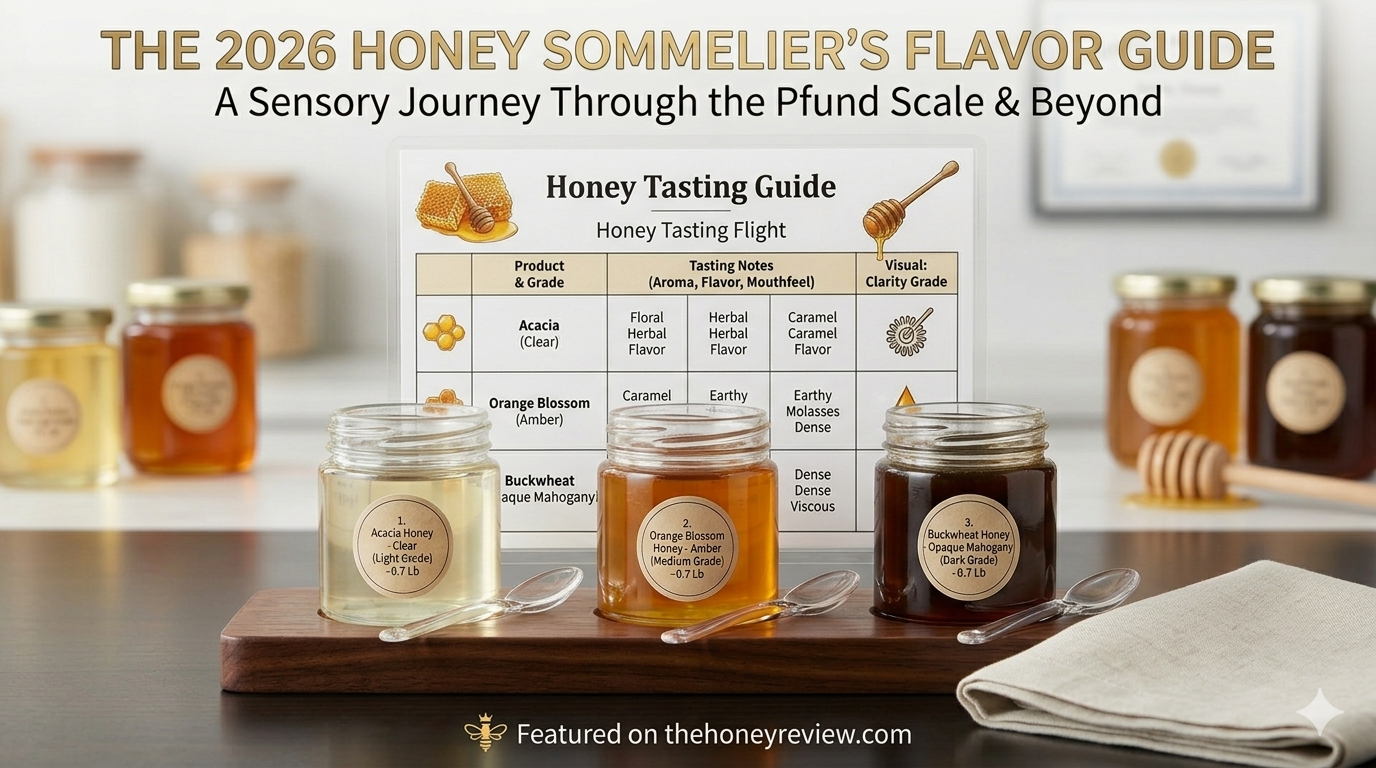
In the professional world of apiculture, “sweet” is merely the baseline. To identify honey like a true Sommelier, you must possess the ability to dissect a jar into its molecular components—aroma, viscosity, and the elusive “terroir” of the landscape. Whether you are auditing a rare jar from the Manuka Vault or comparing local varietals from your own backyard, your palate is your most critical piece of lab equipment.
We have compiled this guide to categorize the three iconic profiles you will encounter, along with the “control samples” required to sharpen your sensory detection.
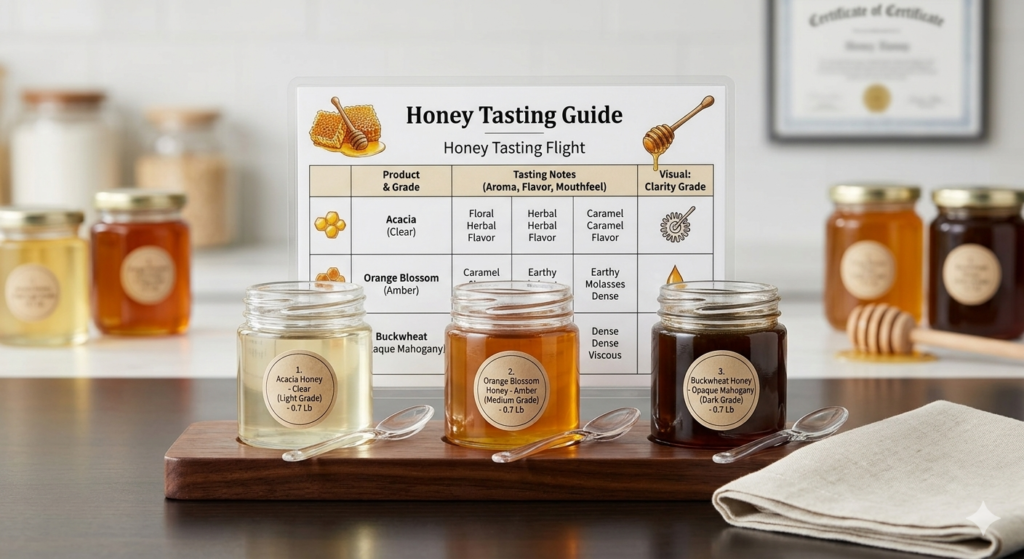
The Sommelier’s Diagnostic Framework: The Three Profiles
1. The Traditionalists: Clover & Alfalfa
- The Profile: Mild, grassy, and clean with a sophisticated hint of cinnamon or vanilla.
- The Texture: Typically liquid or exhibiting fine, consistent granulation.
- Sommelier Note: Consider this the “White Wine” of the honey world. It is light, delicate, and unforgiving; because the flavor is so subtle, any industrial interference is immediately detectable. If you encounter a heavy chemical aftertaste or a metallic finish, it is a definitive red flag for industrial processing.
2. The Appalachian Gold: Sourwood
- The Profile: Deeply aromatic, characterized by intense notes of anise, baking spice, and burnt caramel.
- The Texture: Viscous and slow-pouring, demonstrating a high density.
- Sommelier Note: Sourwood is the “Bourbon” of honey. For those of us based in the Southeast—specifically here in the Piedmont of North Carolina—this is our home-turf advantage. True Sourwood possesses a distinctive, lingering “twang” at the end of the palate that no mimicry can replicate. If the finish is flat, it’s a failed harvest.
3. The Bold & Earthy: Forest & Buckwheat
- The Profile: Pungent, malty, and “barnyard” (in the most elevated, complex sense). Think dark chocolate, molasses, and aged tobacco.
- The Texture: Dark, dense, and often completely opaque.
- Sommelier Note: This is the “Stout Beer” of honey. These are mineral-heavy, medicinal powerhouses. However, treat this as a forensic warning: if a dark honey tastes like thin corn syrup, it has fundamentally failed the forensic sniff test. Real Buckwheat honey should hit your palate with weight and complexity.
The Forensic Tasting Kit: Calibrating the Palate
To evolve from a novice to a professional auditor, you must establish a baseline using reliable “control samples.” I recommend a curated approach to expand your sensory range.
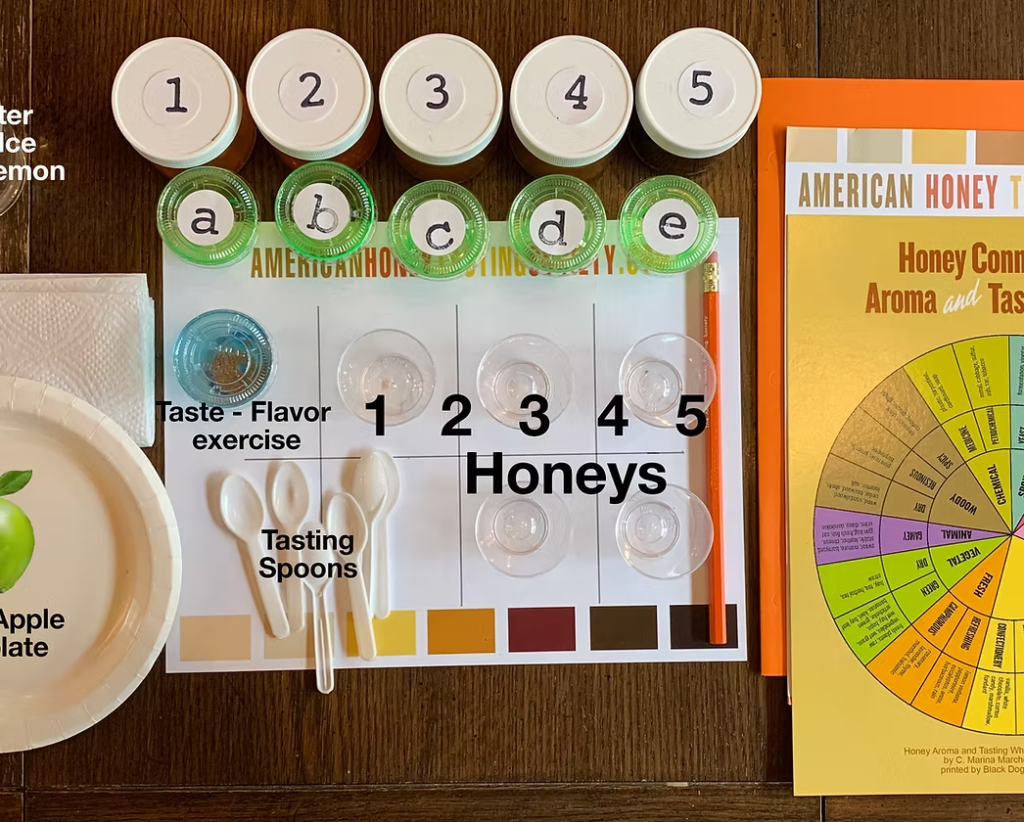
The Gold Standard: The American Honey Tasting Society
For the serious student, I recommend the American Honey Tasting Society (AHTS), founded by C. Marina Marchese. Marchese is, in my professional opinion, the definitive authority on honey sensory analysis. I have personally completed their training kit, which includes an accompanying online curriculum. It is an incredible investment for anyone looking to formalize their knowledge of honey’s structural nuances.
Recommended Tasting Modules
- Bee Inspired Honey Tasting Tower: The ultimate “textbook.” By tasting distinct floral sources side-by-side, you calibrate your palate to differentiate between delicate wildflower and aggressive varietals.
- Raw Hawaiian Honey Sampler: Use this to introduce “wildcard” notes. Varietals like Lehua provide unexpected marshmallow and exotic floral profiles that force your palate to step outside the familiar Appalachian or Clover boundaries.
- Raw Wildflower & Buckwheat Bundle: The perfect tool for practicing the “Earthy vs. Floral” divide. Use this to map the transition from light, nectar-driven notes to the heavy, mineral-dense profiles of darker honeys.
The Lab Protocol: Developing Your Sommelier Senses
To conduct a professional audit, follow the “Three-Stage Forensic Tasting Method”:
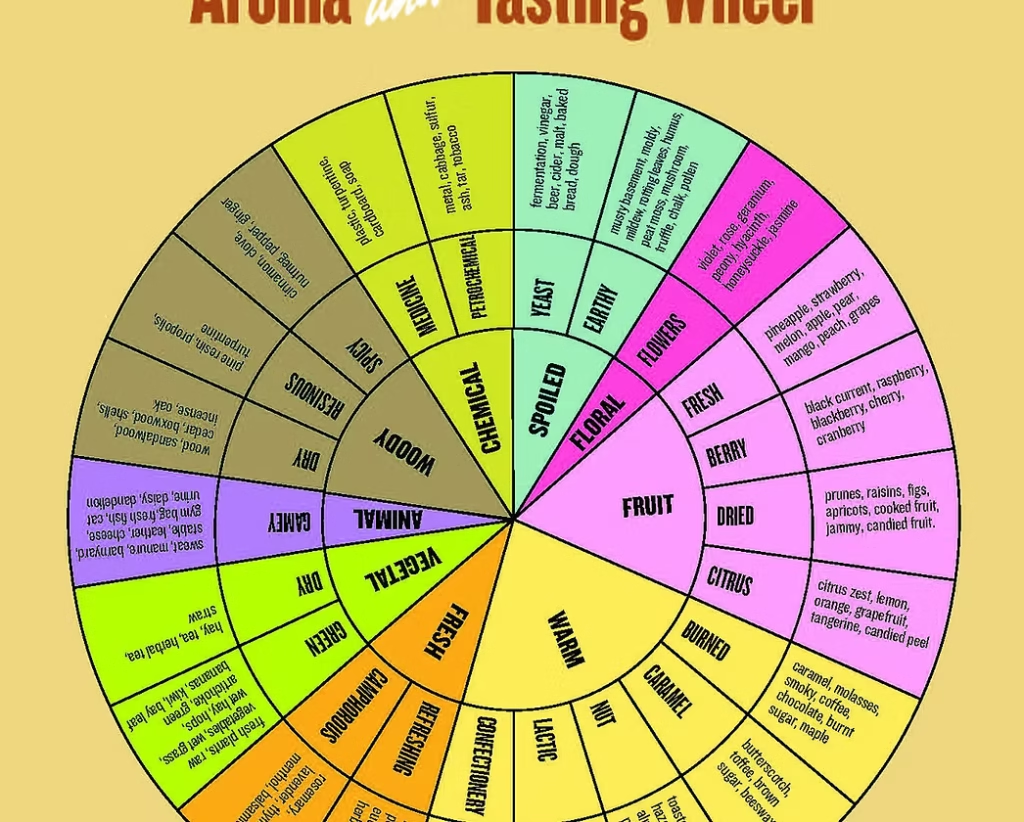
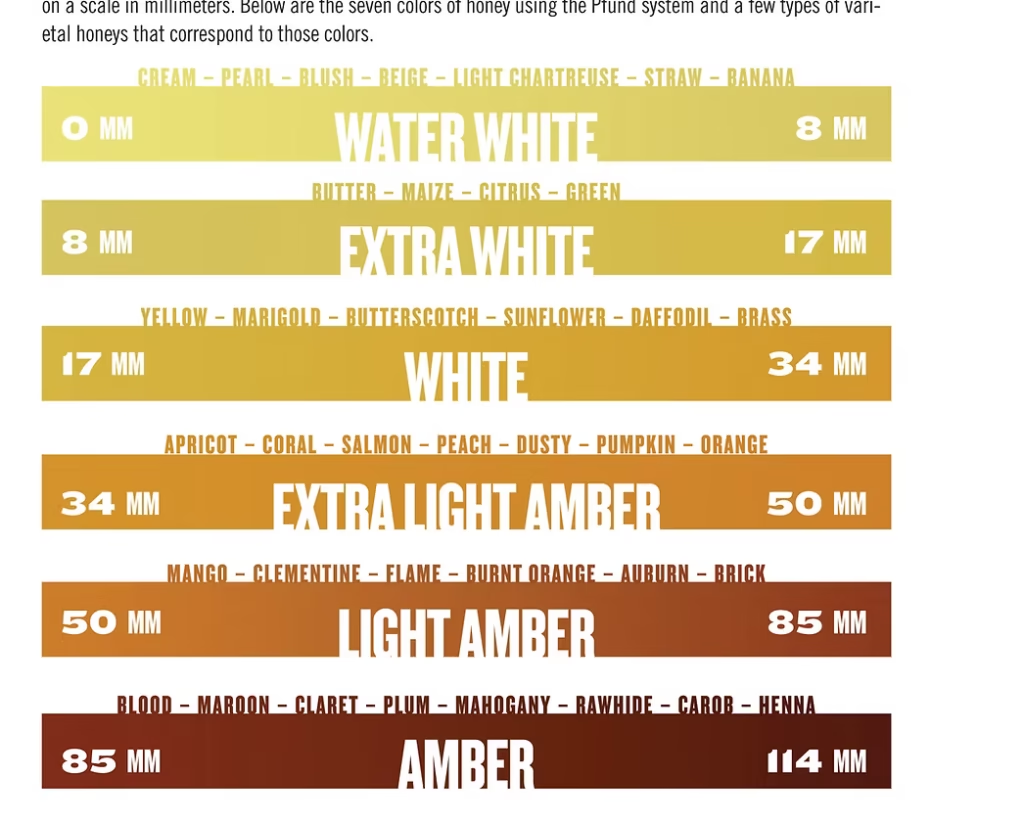
- The Olfactory Audit (The Sniff Test): Before the honey touches your tongue, warm the jar slightly in your hands. Take a deep, controlled breath. Does the aroma dissipate immediately (a sign of heat-damage), or does it evolve, revealing secondary notes of spice or earth?
- The Viscosity Audit (The Mouthfeel): Allow the honey to coat your tongue. Does it melt like silk, or does it leave a waxy, sticky residue? High-quality raw honey should have a “Satin Adhesion”—it coats but eventually dissolves without leaving a sugar-film residue.
- The Finish (The Palate Lingering): A great honey should have a “finish.” Just like a high-end wine, the flavor should transition. If the initial floral sweetness disappears and is replaced by a complex, savory, or mineral note, you are dealing with an exceptional harvest.
Forensic Scorecard Example: The Sommelier Standard
- Floral Integrity: 5.0/5 (Are the notes recognizable and distinct?)
- Aroma Complexity: 4.8/5 (Does it pass the Olfactory Audit?)
- Viscosity: 4.5/5 (Does it meet the “Satin Adhesion” benchmark?)
- Terroir Transparency: 5.0/5 (Does it reflect its geographic origin?)
- Vault Status: VERIFIED or REJECTED
The Quick Breakdown
| Forensic Pros | Forensic Cons |
| Palate Evolution: Forces you to identify specific floral markers. | Time Intensive: Requires deep attention and control samples. |
| Medicinal Insight: High-mineral honeys are easier to spot. | Cost: True educational kits represent a financial investment. |
| Quality Control: You become immune to “plastic bear” marketing. | Availability: Rare varietals can be hard to source locally. |
The Verdict
Study this guide if: You want to elevate your kitchen game and finally understand why a $20 jar of artisanal honey is objectively superior to a $4 mass-market bear.
Skip this if: You are only interested in a sugar additive for your coffee or baked goods. But for those who crave the “Sticky Truth,” welcome to the lab.
Forensic “Pro-Tip” for 2026
When doing a vertical tasting of three or more honeys, cleanse your palate with a crisp green apple slice between samples. The acidity of the apple resets your taste buds, allowing the subtle nuances—the “anise” of the Sourwood or the “vanilla” of the Clover—to register clearly in your next audit.
Ready to test your skills? Head to the Review Archive to find your next “control sample” and start your own personal Vault today.